Tuesday, April 28, 2020

NO FIRST SATURDAY WORKDAY IN MAY

CAHOOTS/WHITE BIRD CLINIC


Arlo, the office manager at Cahoots has reached out requesting mask makers.  They'd like you to use the Belgian pattern, but use surgical wrap for the outside layer.  They'll provide that.  They request that you plan to pick up the wrap between 10am and noon, and to call first to make sure they haven't run out of supplies.  Their letter is below:  

Hello everyone! 

If we haven't met yet, my name is Arlo; I am the office manager at CAHOOTS. I am also the resident crafty person at White Bird. You have all expressed interest in sewing handmade masks, which is amazing!! I wanted to reach out to everyone in one thread to keep things streamlined. 


These masks will be used for patients and potentially exposed folks, who will need to keep a mask on at all times to prevent those around them from risking exposure to the virus. Our medical folks have a specific way they want these to be made so that we actually use them. The #1 key to this is materials! 
   -The outer layer needs to be fluid-repellent. If you have access to other breathable and water repellent products, that's great.Otherwise, we will have SURGICAL WRAPS available for pickup at our main clinic, 341 e 12th ave, for folks to cut up and use as the outer layer. These are fluid and bacteria resistant, and have a non-woven structure. I personally am using these. 
   -We are asking folks to use whatever woven cotton material they have on hand to use as the lining layer and straps. I am using whatever bias binding and twill tape I have on hand to make straps but you can easily use cotton fabric as well. We are asking folks not to use elastic, as it both breaks down under heat and usually contains latex which can cause allergic reactions.
   -I will personally handle cutting and inserting the filter material; we are using vacuum bags, but we only need sewing folks to create the masks that these filters will be inserted into. 

I have attached a pattern and detailed instructions that I would like us all to use, to keep things consistent. There are large, small, and child sizes included, but we do not currently have a demand for child-size masks so we are only making adult small and large sizes. I find that the large mask is more universal, as even if you have a small face you can tie it tight and wear goggles (or glasses in a pinch) over the nose bridge to seal everything in. If you feel able to, adding a simple channel to the middle third of the top edge allows us to insert an optional wire that serves a similar purpose. 

Materials Pick-up: Call the main clinic between 9-5 any day of the week and ask them when would be a good time to come pick up surgical wraps for mask making. They will instruct you from there. Sanitary pickup of donations and materials has been going very smoothly at 341, so please rest assured that we have your safety in mind. If you absolutely cannot pick them up we have limited ability to deliver; our facilities folks have graciously offered about 20 minutes a day they can devote to this. Text me at 503-807-5104 if you need help with this.

WHEN THE MASKS ARE COMPLETED, please wash them one last time before packaging them up, but know that they will also be sterilized before use. Please drop them back at 341 e 12th, preferably with a little note that explains that they were made under the guidance of Arlo and fit the specifications we set for this project.

If you have questions, please text me at the number below. If you plan to participate, please respond to this thread and I will help facilitate pickup of materials. Thanks for putting your energy into this and for caring about our community! 

Best,

Arlo Silver
CAHOOTS Office Manager
White Bird Clinic
(541)-342-8255 ext. 140

Most recent email: 
 Hello Mask Folks,
I hope this find you well. If anyone has future plans to pick up materials at our main clinic (341 E 12th Ave), the team has asked that pickups be limited to 10am-12pm daily from today onward. Please still call ahead at 541-341-8255 to make sure they are ready for you and have supplies stocked. 

This is where you'll find the Belgian pattern that Arlo is requesting, and in my blog post  of 3/29 (Much more about masks) has more info.   


They've since posted that they're happy to take any style you make!

PANTYHOSE!


Interesting article from NPR.  I'm going to try this if I can find an old pair in the back of some drawer!

DAILY EMERALD


Here's an article in the Daily Emerald about all the masks being made in our area.  I hope many of you are still making them, as the need continues.  Remember to let me know if there are supplies I can provide.  If you'd like your finished masks picked up, this group does that too.

NO WORKDAY IN MAY EITHER


What a strange and horrible year 2020 has been.  I hope you're all being as careful as possible.  We won't be gathering to meet this first Saturday, but of course I encourage you to work individually at home.  We've had people doing various kit-making tasks at home, and of course many of you are making masks too.  Let me know if you'd like some homework (contact-free handoffs)!  


ANOTHER STUDY OF MOST EFFECTIVE MATERIALS


Friday, April 17, 2020

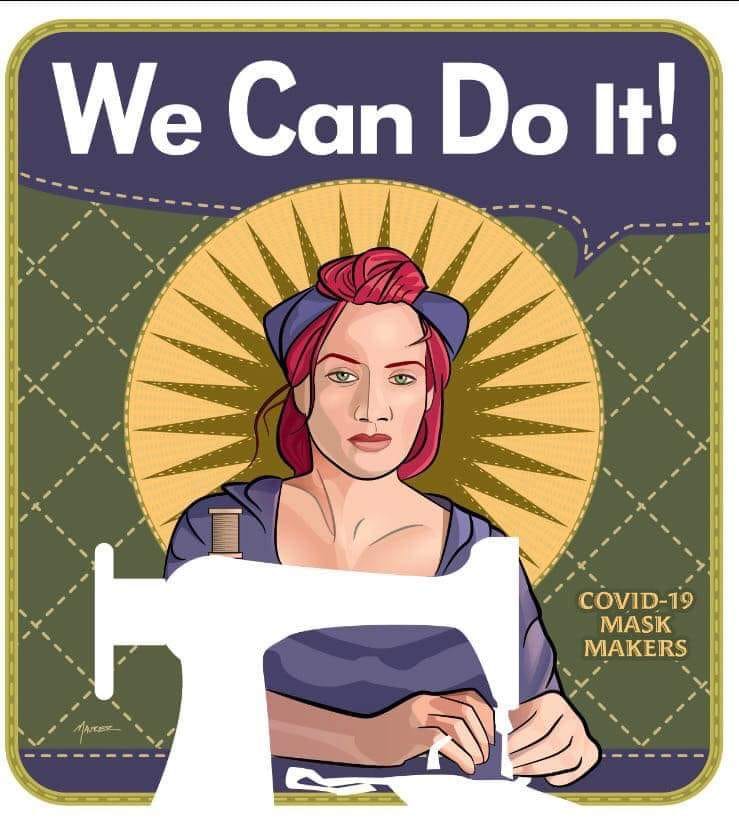
WE CAN DO IT!

We Can Do It!

PLEATING JIG

I made a cereal box contraption for folding evenly spaced pleats, last week, but this one looks much better!  

QUICK WAY TO MAKE BIAS TAPE

Here's a slick trick that looks like quite the time-saver!  If you don't have one of those Clover bias tape gadgets or a tape making attachment to your sewing machine (or even if you do!), try this.  It's amazing--no strip folding, no pressing (unless you want to), and very fast!  And remember, for masks, you don't need the ties to be bias.  Width of fabric works great.


WHAT WE'VE BEEN SAYING

This is from a nurse, posted elsewhere:

I need to offer some advice to mask makers. I am a nurse and a sewist who is currently wearing homemade masks daily now. I have seen lots of patterns and adaptations. Some of the masks being donated are sadly unusable.  

1) only quality cottons. We are getting masks made from fabrics that are satiny, loose weave or nonwashable fabric. 
2)don't put a filter in--let us decide what filter to use. Masks that have a variety of "filters" including coffee filters and paper towels cannot be washed.
3) Keep it simple. Masks that are quilted or embroidered are compromised. There are now a million needle holes in the fabric for contamination to pass through.
4) we do appreciate the masks! Supplies are extremely limited. A well made simple mask can literally make a terrible day tolerable. Thank you for your support!
My additional comments from 40 years of experience.
A. Back needs to be a different color fabric so there is an identifiable front & back. For example a solid color cotton for back works well.
B. Elastic loop for ears only are very uncomfortable after wearing a while. 100% cotton T-shirt ties work well for ties.


BUTTONS!


As the nurse stated above, health care workers who wear the mask style with elastic that goes around the ears say their ears ache after a while.  Some some people are sewing buttons to 2"-3" wide headbands and they can hook the elastic to those.  Here's a tutorial on how to make your own headbands out of knit.  There are others--just google!  And if you need t-shirt type cotton knit fabric, let me know.

I found this simple idea on Facebook.

Here's another idea--a crocheted, sewn, or grosgrain rectangle with buttons or aluminum can pull tabs,  to wear at the back of the head and hook the elastic to.  Such creativity.

I'll be happy to get any of these that you make to distribution points.  


NICE LITTLE VIDEO


Here's a CBS Sunday Morning feature on mask makers.  Wouldn't you like one of those cutting tables?


MASK KITS AT PEACEHEALTH

Some of us have picked up, sewn and returned mask kits to the Riverbend Annex on International Way.  They're very quick and easy to make.  I'd heard that the surgical wrap fabric used was being cut and kits prepared for us by a local company.  Here's an article about that.  


WHICH MATERIALS WORK BEST?

This New York Times article rates them.  I'm currently using batiks, with their high thread count.  


NARROWING DOWN THE CHOICES

I've tried and tweaked so many mask patterns!  I want something that has an opening for the wearer to insert a filter, has ties rather than elastic (for ear comfort), and a good fit at the bridge of the nose.

I've now narrowed it down to two I prefer, and I use batiks at least on the outside layer.  

1.  The Belgian pattern is great, and my latest tweak is to create the opening in the back by making the front fabric longer and the back shorter (still the same  combined total length), so that the two horizontal seams connecting them (at both ends) both end up on the back, rather than the top and bottom.  Then I leave a 3" opening in one of the seams (for inserting the filter) and have that near the bottom on the back. There are options for what you use to mold the mask around the nose. Something that doesn't rust can be inserted and sewn in place.  If your choice is something that rusts, you'll have to leave an opening in the casing so it can be removed for laundering.  See "3 Types of Nose Thingies" below.

2.  My other favorite is one Glenda shared with me, that her Corvallis guild uses.  It fits very nicely on all my testers' faces, thanks to darts, top and bottom.  And because the darts shape it, it doesn't need a stiffener for the bridge of the nose.
Here's the link!

WHERE?

Feel free to drop your masks off at my house.  I have a plastic tub on my driveway porch, for that purpose.  And of course, there are many other places.  Here's a link that suggests several locally.  

I urge you to also check out this active Facebook group of area mask makers: 

The Seamsters: Facemasks for Health Care in Eugene-Springfield, Oregon


If you go to their page, be sure to read the announcements!

Attachments area

3 TYPES OF NOSE THINGIES THAT ARRIVED THURSDAY


Ellen of the Central Oregon Chapter suggested these garden ties to me, I ordered more of the covered paper clips that I've bent and used before, and these strips of aluminum (no rust!) were donated by a Portland Chapter of the SMART sheet metal union members and contractors.  I received several hundred of them, and would love to share with our mask-making volunteers.  Does anybody have any ideas/equipment for  efficiently rounding/grinding the 4 corners?  Do any of you want to take on that responsibility, perhaps a non-sewer, a spouse, a bored teen?

GAME CHANGER

Many of us have been dismayed to learn how much in hospitals is discarded after a single use, because that's more cost- and time-efficient than sterilizing for reuse.  This couple has come up with a way to sterilize 80,000 masks a day.  


VIDEO

This is a must-see video of how simple mask-making is!  Guaranteed smile-maker.

Wednesday, April 8, 2020

APRIL 8TH UPDATE

QUILTING STUDIOS BECOME MASK FACTORIES

Around the world, tens of thousands of Days for Girls volunteers are turning their attention and skills and sewing/quilting rooms to making face masks these days, rather than washable menstrual kits.

With drastically reduced travel these days, kit distributions are on the back burner as we try to save lives by making masks that will help us keep each other healthy.

Of course, there will be kit distributions in the future, and we'd love to be ready for requests, so if you'd like a contact-free handoff of homework, please let me know.


PLEATS, FIVE MASKS AT A TIME


Lia shared this helpful pleating video.

TODAY'S TWEAKS TO THE BELGIAN MASK PATTERN


There's an online video of a guy whipping out a mask in a few minutes.  He pleats both pieces of fabric at the same time, no measuring, no pinning. That inspired me, because I'm not a speedy sewer.  I have made a pleat presser aid that works well, using a cereal box and blue painters's tape, and that enables this step.  I think though, once you've made a bunch of masks, pleating "by eye" works pretty well. 

Here's something that you'll probably find handy for sewing down pleats, no matter which pattern you're following.  This is cardboard, but I've also used a small Omnigrid ruler.


No photo description available.

Since our necks are considerably smaller than our heads, I've reduced the length of the bottom ties to 16".  Why waste ribbon? (Remember, I bought many spools of 1/4" grosgrain, so if you need some for masks, please let me know).

I'm using different fabrics on the two sides.  That way, you can remember which side you've had against your face if you take it off for a bit.  If you use the same fabric, inside and out, please mark the inside in some way.  Please remember that the pleats should always face down on the outside of the mask.

As I make more masks, try different styles, watch videos,  etc., I try different tweaks.  On the Belgian mask pattern, I have been pleating the two layers at the same time.  It may be a bit slower, as I want to make sure I've got the steps in the right order.  But the more we do a particular method, the more efficient and speedy we'll become.  

If you choose to use part of a pipe cleaner, gardening wire, twist tie, etc., instead of a paper clip, you can narrow that "nose pocket" and insert & stitch to enclose your nose piece as you're constructing, leaving an opening for removal.  Be sure you've bent back the tips of the pipe cleaner  or wire so they don't poke anybody or make a hole in the fabric.

HERE'S ANOTHER PATTERN I LIKE

Every day I seem come across a new pattern that seems to address the best mask features differently and sometimes, in my opinion,  better.  Here's a design and video that I think fulfills most of the things on the "wanted list."  I would add whatever you're using for shaping around the nose and stitching to keep it in place but removable, but other than that, it's easy and you can use the grosgrain ribbon that I ordered (let me know if you need some!).  


NOSE SHAPER OR NOT?

If the "shaping around the nose" thing bewilders you, contact me and I'll explain!  A nurse has told me this is an important feature. But, as with everything else mask-related these days, there are varying opinions.  A local group producing and distributing  thousands of masks says:


Should we insert metal or plastic in the nose bridge?

We recommend not including these pieces. Nose bridge flexibility is a nice customization, but the metal or plastic will be useful for the first use of a mask and will have to be discarded after that. If you do include a nose bridge piece, please leave an opening to easily remove it.

I addressed leaving an opening for removal of a paper clip in the March 29 post.  I've also been sewing in pipe cleaners, but you can easily leave one end of that enclosure open too.  I add this feature last:  The seam at the top of the mask is the top of your enclosure, then, sew (through front and back of mask) one side and the bottom of the  enclosure rectangle, leaving the other side open for inserting and removing.  This space should be just a smidge longer and wider than your nose bridge piece so it will stay put.  And centered, of course.


DIG OUT YOUR BATIKS!


Some fabrics do better at filtering than others, research says.  Read this NBC News article.

WARNING

PLEASE SHARE: WARNING
Some mask-making info, including advice to use hepa filters, has been posted on various social media sites by a doctor. It went viral, and now lots of people are making masks with hepa filters from vacuum cleaner bags, air co filters, etc. PLEASE NOTE: Hepa filters contain carbon/charcoal and often, also fiberglass! These can cause serious lung problems and are especially dangerous to those who already have COPD or lung conditions! Other medical professionals have been highly critical of the advice to use the hepa filters. Vacuum cleaner bag manufacturers are also trying to warn people not to use the hepa filters! Please share this and help prevent even more trouble!  This doctor says no HEPA filters.


WHAT'S GOOD FOR A REMOVABLE FILTER?

There are many interesting ideas out there--coffee filters,  rinsed out and dried diaper wipes, 2 layers of paper towel, garden fabric, etc.  I think what's used inside is pretty much up to the end user, as that's the person who's going to have to be removing and replacing.  You're doing the hard part--making the masks and leaving a pocket for them to insert their filter of choice.  


ELASTIC HURTS THE EARS

There's strong feedback that masks made with elastic to hook around the ears are painful to wear for extended periods of time, as health workers would.  Here's a 3-D printed little device that the elastic can be hooked to behind the head, taking burden off the ears.  It's approved by the National Institute of Health.  The creator has shared the pattern.  If you know somebody with a 3-D printer who'd like to help in this effort, please recruit them.  Masks are faster to make with elastic, so quantities of these would be great, and very appreciated by the health care workers!  But then there's the sterilization issue:

And this warning:  Why cotton fabric ties? Why not use elastic?
Cotton ties hold up under the intense heat of hospital sterilization. Typical home laundry is 100–120 degrees. Sterilization is 180–200 degrees. Elastic breaks down after only a few uses of the mask when laundered at high heat. Cotton ties will extend the life of the mask for many reuses. Elastic can also trigger allergic reactions for some people, as it can contain latex.

So, if your mask is not going to a medical setting where it will subject to sterilization, and your users prefer a style using elastic, that's fine  Our grosgrain ribbon ties are best not sterilized at high temperatures either, because they're 100% polyester.  But they're fine being washed and dried on hot in our domestic machines.

Making your own ties out of cotton is great.  If you've got a bias tape maker, it can be fairly fast.  There are many posts online.  And don't cut the fabric on the bias--width of fabric is better.  I've seen Pinterest and Facebook posts where somebody used a (hair) flat iron or a laminator to speed up the pressing part!  Many use a couple of pins on their ironing board, as a substitute for a bias tape maker.  And some folks may have a bias tape maker attachment for their sewing machines--those really speed things up!

BLUE SHOP TOWELS, BY BRAND

Some testing has been done on these blue towels, and the results are promising.

THE FUTURE

We know that it's uncertain how long this pandemic will be with us.  I suspect there may be high demand for masks for longer than we think--both for medical workers and the general public.  Please continue to crank out these masks that will help keep us from spreading germs of all kinds.  Thank you!

Mary Jo told me last night that in China, the government sends each family their allotment of masks each month--they're normal attire! 

If you need grosgrain or fabric, please let me know! 

I'm happy to receive the masks you have to donate (Days for Girls HQ has sent four requests to us so far) or you can contribute them to groups and individuals that you've heard about needing them.

HQ would love to know how many masks our chapter volunteers produce, so please let me know if your mask donations don't go through me.


MAKING A CONTRIBUTION TO OUR CHAPTER

If you'd like to make a financial donation to the Eugene/Springfield chapter,  here's where you can do it online.  Checks can be made out to Days for Girls, with "for Eugene, OR chapter" in the memo line, and sent directly to Days For Girls, PO Box 2622, Mt. Vernon, WA 98273.  Online donations incur that pesky processing fee, whereas we receive 100% of checks.

Tuesday, March 31, 2020

TUESDAY UPDATE

HOW'RE YOU DOING ON MASK-MAKING?


I've shared various places to drop off masks you've made that will be distributed to locations that have requested them.  I've taken the batch I made to the hospital.  Many more are in various stages.  

Days for Girls now has a place on their website where facilities can  make a request for masks, and then a the leader of a chapter in that region receives an email asking if they can fill that request.  Yesterday I got two that way, and one through another DFG chapter leader on Facebook.  I have none ready to go.

If you are sewing fabric masks at home, and not for a specific request, please consider dropping them in the box I have outside on my driveway side porch.  Email for the address.  

Here's a website to request that somebody pick up finished masks from you, if you're not driving anywhere.  Go to I have materials for making masks that I want to donate (such as fabric), click NEXT and you're on your way.  They will pick them up and deliver them to a facility that's requested them.

I PROTECT YOU.  YOU PROTECT ME.


While we all know the N95s should be reserved to protect medical workers, the cloth masks apparently are pretty effective at helping us keep our germs to ourselves.  Like the Czechs are saying, "I protect you.  You protect me."


GROSGRAIN TIES


If you're making the style mask that uses ribbon for ties, I now have some 1/4" grosgrain to share with our DFG mask makers.  The cut ends need to be waved close to a candle or other flame/heat source to melt the fibers so they don't fray.  

I'm using the grosgrain ribbon for the ties with the Belgian style mask--I posted the pattern at the end of the previous post.  The mask is made of cotton, and has a pocket to insert some sort of wire (folded pipe cleaner,  bent paper clip, etc.) to hold it snug around the bridge of the nose, plus a pocket where a filter can be inserted.  

Let me know if you need grosgrain, bias tape, cotton fabric or some 1/4" elastic.  

EDITS AND TWEAKS


The more I work with a pattern, the more I want to refine it.  If you've printed out my instructions (previous post) for the Belgian-designed mask, please note that I've made some minor changes and you may want to reprint.  Or wait a day or two , and see what else I add.  This evening I used a construction method that I think saved me time--I'll post if that proves correct.

Sunday, March 29, 2020

MUCH MORE ABOUT MASKS. (updated Monday at 8 pm)

HOSPITAL OUT OF SURGICAL WRAP

I just talked to Sherrie, the head of  volunteers who has been coordinating the distribution of kits for making masks out of the surgical wrap.  Because it's used for wrapping instruments used in surgeries, and surgeries are way down, they've run out of the wrap.  Slocum is expected to bring some by, but she doesn't know how much nor when more kits will be ready for us to pick up.  And, it will still be one per person as they run out so fast and so many of us are wanting to make them.

She also told me that some people are making masks using the wrap, and not returning them.  Please don't do that--they need those for their staff members who work with patients!

A day or two ago they posted a request for us to make cloth masks.  Please do that!  You can drop them off there, at Peter Defazio's office, at Lane County Public Health or at my house. 

FROM THE CZECH REPUBLIC

The Czech Republic took the uncommon step last week of making nose and mouth coverings mandatory in public spaces, prompting a grassroots drive to hand make masks.

If everybody wears a mask when they go outside, look what happens.  Masks fundamentally prevent the transmission from you to others.
I protect you.  You protect me.

And here's another link about masks for everyone.

Here's another from Science Magazine.


MASKS OUT OF BASEBALL UNIFORM FABRIC


What to do with all those yards of pinstripes for making baseball uniforms, when the season is cancelled?  How about masks?


TEN MILLION A WEEK

A textile company is organizing other corporations in a national effort to ramp up production of face masks for healthcare workers.


Read morSTERILIZE MASKS?e here: https://www.charlotteobserver.com/news/coronavirus/article241413386.html?fbclid=IwAR3ihF2tnxW9PXF9l9cfknAZWc-i_tCqokos8hsiXZAKvEoxMnhiRPtSOJ0#storylink=cpy


WILL YOU MAKE A FEW TO HELP OUT LOCALLY?


Can you take some time to make a few masks?  Pass them out to your friends and family.  And if you have more time (remember, we are sheltering at home), crank out a bunch that can be distributed to all the places around town that are caring for others.  Your choice of where, or drop them off here.  I have a tub on my driveway porch.

I gave tips and links to some patterns in emails this week.  The internet has those and many more.  The one I'm currently using is from Belgium. I'm pasting it below:


BELGIAN FACE MASK

These directions go with the video and templates at this website:  https://makefacemasks.com/?fbclid=IwAR0ti1Gq-vSyVHgix1kv1sGumKTTF12PZV0K4IO1uw7J8S7mqivlDBQVcac

I added the pocket for a paper clip, pipe cleaner or ? at the bridge of the nose.  As with the pocket for the filter, it's there if they want to use it.

Use good quality fabric with a high thread count, not the same for the inside and outside.  I’m currently using white on the inside     
                                               Height            Width.      (of mask)
Front Fabric 8-1/8  x  7-7/8
Back fabric 7-1/4  x  7-7/8
Ties Four 20” (1/4”—1/2 ”wide) 
                               This a very generous length, especially around the neck. I'm making
  tweaking this and making the lower two ties 16" each.


  1. Fold and stitch 1/4” at bottom edge of both front and back pieces
  2. Fold front bottom up an additional 1/2” and stitch at side edges
  3. Press the pleats and pin or Wonder clip
  4. Stitch pleats at edges
(I ACTUALLY COMBINE STEPS 2, 3 & 4 AND STITCH THAT ALL IN ONE GO.)
  1. Put fabrics right sides together and stitch at top (1/4” seam allowance)
  2. Pin the 4 ties at the corners, length to the inside
  3. Stitch the sides, reinforcing where the ribbons attach
  4. Turn right side out.
  5. Stitch pocket at top center, leaving opening to insert nose “clip”. To make a pocket, find the top middle of the mask.  Your pocket should be 3” wide, centered, with an opening of 5/8”-3/4”.  Just stitch like this:
_____________________top of mask _________________
   I                                                                             I
   I                                                                             I

   I_ _ _ _ _ _ _ _ _ _ _ __ _ __ _ _ _. _ _ _ __             I            


Saturday, March 28, 2020

KIT MAKERS TURN TO MASK MAKING

We've had a wonderful response from local sewers to the shortage of medical masks.  Our Days for Girls chapter volunteers as well as so many others have been cranking out masks in a variety of styles, sharing tips and new patterns, places to get supplies, places to drop off completed masks, etc.  There's even a new Facebook group for local mask makers.  If you're on our email list, you're probably sick of my recent emails about all of this.

I'm thrilled to see that it's not just a local boom in mask-making, but that it's people who sew all around the country stepping in to help with this need.  

Here's an article from the New York Times yesterday.

And while I have your attention . . . no, we won't have a workday on the first Saturday in April.  I urge you to work on masks at home though.

Saturday, March 14, 2020

STAY HEALTHY, PLEASE!

PERIOD POVERTY IN KENYA


Nice article in Aljazeera about period poverty in Kenya.


TV COVERAGE OF A DAYS FOR GIRLS CHAPTER

Please ignore the Jerry Springer (!) commercial at the beginning of the news piece.  I spied a reddish print in a shield that we've used in ours.  Several times a week? I'm very impressed.


NO TAMPON TAX?


Interesting article from the BBC.  The tax was supposedly used to benefit groups supporting vulnerable girls and women . . . but that means only menstruating women were supporting these efforts, rather that the population as a whole.


NO MARCH AND APRIL WORKDAYS 

This nasty Covid-19 is disrupting so much.  I hope that we citizens can keep ourselves and our germs away from each other so that it really can't get the foothold they're expecting.   We can do our part by not getting physically close to each other when that is an option.  And, skipping some workdays IS a smart option.  We now know we won't be meeting at least until after April.  Stay tuned, please.

This morning, I received an email from Celeste Mergens, Days for Girls founder and CEO.  I share it with you:  

Dear Days for Girls family,

We hope this message finds you well. As a global health organization, the safety of communities and all Days for Girls volunteers, team members, supporters is very important to us. While coronavirus (COVID-19)* continues to impact us all, we wanted to take a moment to reach out and share our ongoing commitment to best health practices.

Effective immediately, all DfG volunteer community events around the world are advised to be paused or postponed until after April 30th. This includes Chapter and Team sew and assembly days, and events, though people may continue to serve at home privately.

In addition, Days for Girls is closely monitoring and following the guidance of the World Health Organization (WHO), to ensure that we are doing our part as responsible global citizens.

We urge you to do the same and follow all travel and public gathering guidelines given by your local public health and other relevant agencies.
 
Take everyday precautions:
  • Stay home if you’re sick… at all. 
  • If you have fever, cough and difficulty breathing, seek medical care early. 
  • Stay informed and follow the advice given by your healthcare provider.
Take everyday preventive actions:
  • Wash and encourage others to wash hands often with soap and water for at least 20 seconds, especially after blowing your nose, coughing, or sneezing, or having been in a public place. We are global champs at this, let’s put that expertise to work and set an example.
  • If soap and water are not available, use a hand sanitizer that contains at least 70% alcohol.
  • To the extent possible, avoid touching high-touch surfaces in public places – elevator buttons, door handles, handrails, handshaking with people, etc. Use a tissue or your sleeve to cover your hand or finger if you must touch something.
  • Wash your hands after touching surfaces in public places.
  • Avoid touching your face, nose, eyes, etc.
  • Clean and disinfect your home to remove germs: practice routine cleaning of frequently touched surfaces (for example: tables, doorknobs, light switches, handles, desks, toilets, faucets, sinks & cell phones).
  • Avoid crowds, especially in poorly ventilated spaces. Your risk of exposure to respiratory viruses like COVID-19 may increase in crowded, closed-in settings with little air circulation especially if there are people in the crowd who are sick.
  • Avoid all non-essential travel including plane trips.
If COVID-19 is spreading in your community, take extra measures to put distance between yourself and other people to further reduce your risk of being exposed to this new virus.
  • Stay home as much as possible.
  • Consider ways of getting food brought to your house through family, social, or commercial networks.
As this unfolds, we will all be making adjustments to the way we live, work, and volunteer. Let’s work together for the good of all. Should you have any questions or concerns about a specific upcoming event or activity, please reach out to your regional representative or direct supervisor.

We are committed to working together to support one another through this rapidly evolving situation. Let’s be champion hand washers and have good courage. With precautions, we can help keep more people well and soon things will return to normal and we’ll enjoy shared larger gatherings again.

Stay safe. You matter.

With gratitude,
Celeste Mergens and the Days for Girls team

Mary and Lynne, Days for Girls Australia
Terri-Lynn and Louise, Days for Girls Canadian Society
Helen, Days for Girls New Zealand
Jane, Days for Girls UK
Katy, Days for Girls USA

*To learn about COVID-19 we ask you to visit the FAQ compiled by WHO or your local equivalent.