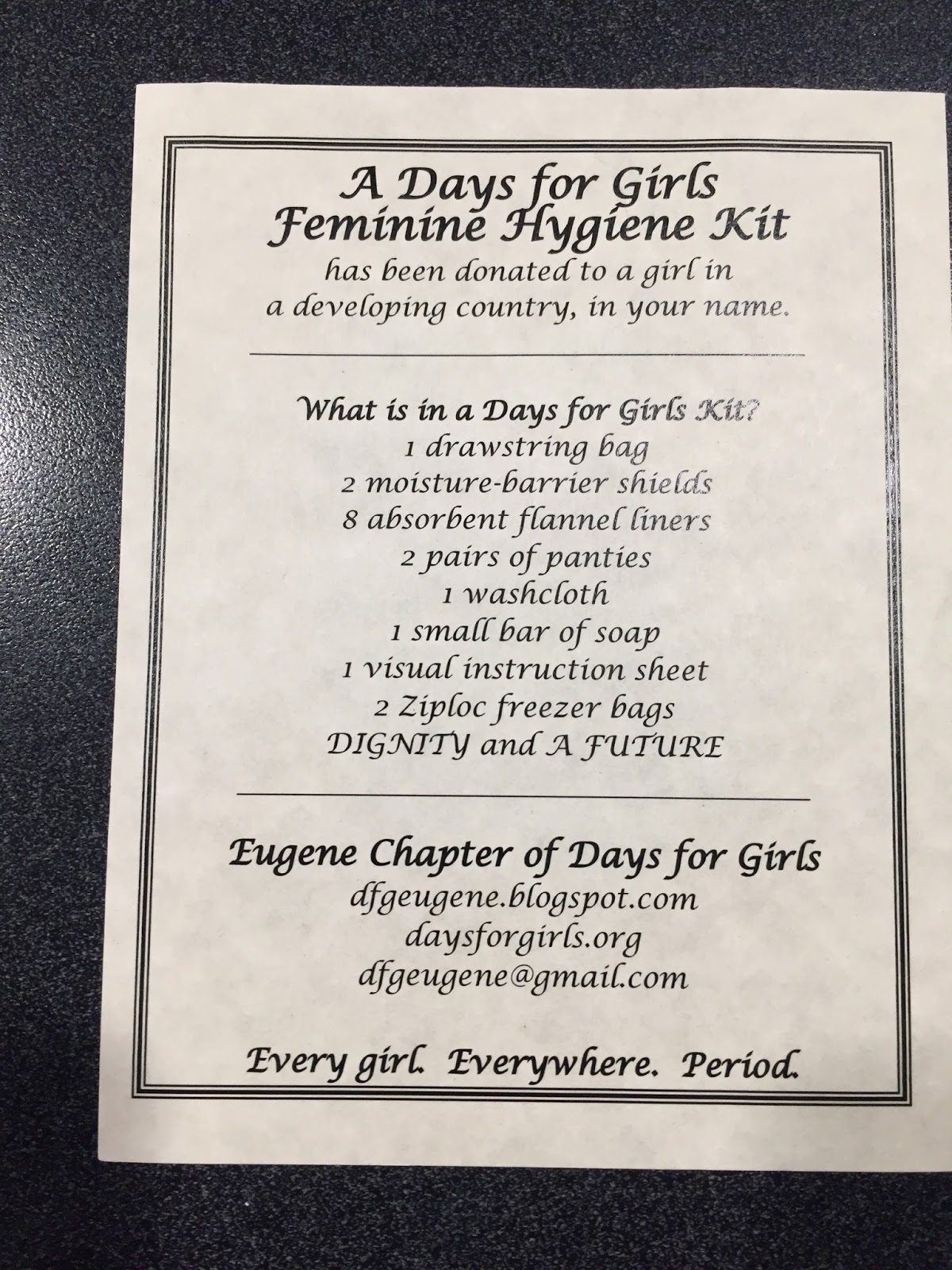
YET ANOTHER DATE CHANGE!
PLEASE NOTE that we are meeting on the SECOND Saturday in February. I hope you can join us at Our Sewing Room on 5th and Main, any time between 10:30 and 4:30 that day! I really appreciate RSVPs to the reminder emails I send out the week before. It helps me know what to pack.WE DID IT! ONE MILLION KITS!!!
Days for Girls Chapters, Teams, Enterprises, Clubs, and volunteers reported their distributions from around the globe, while our partners, supporters, and sponsors created a tidal wave of end-of-year donations. All together, you've just made it possible for Days for Girls to reach our millionth girl--in less than a decade! Better yet, we're building the infrastructure and momentum to get menstrual health solutions and education to
Every Girl. Everywhere. Period.
MEANWHILE, IN EUGENE
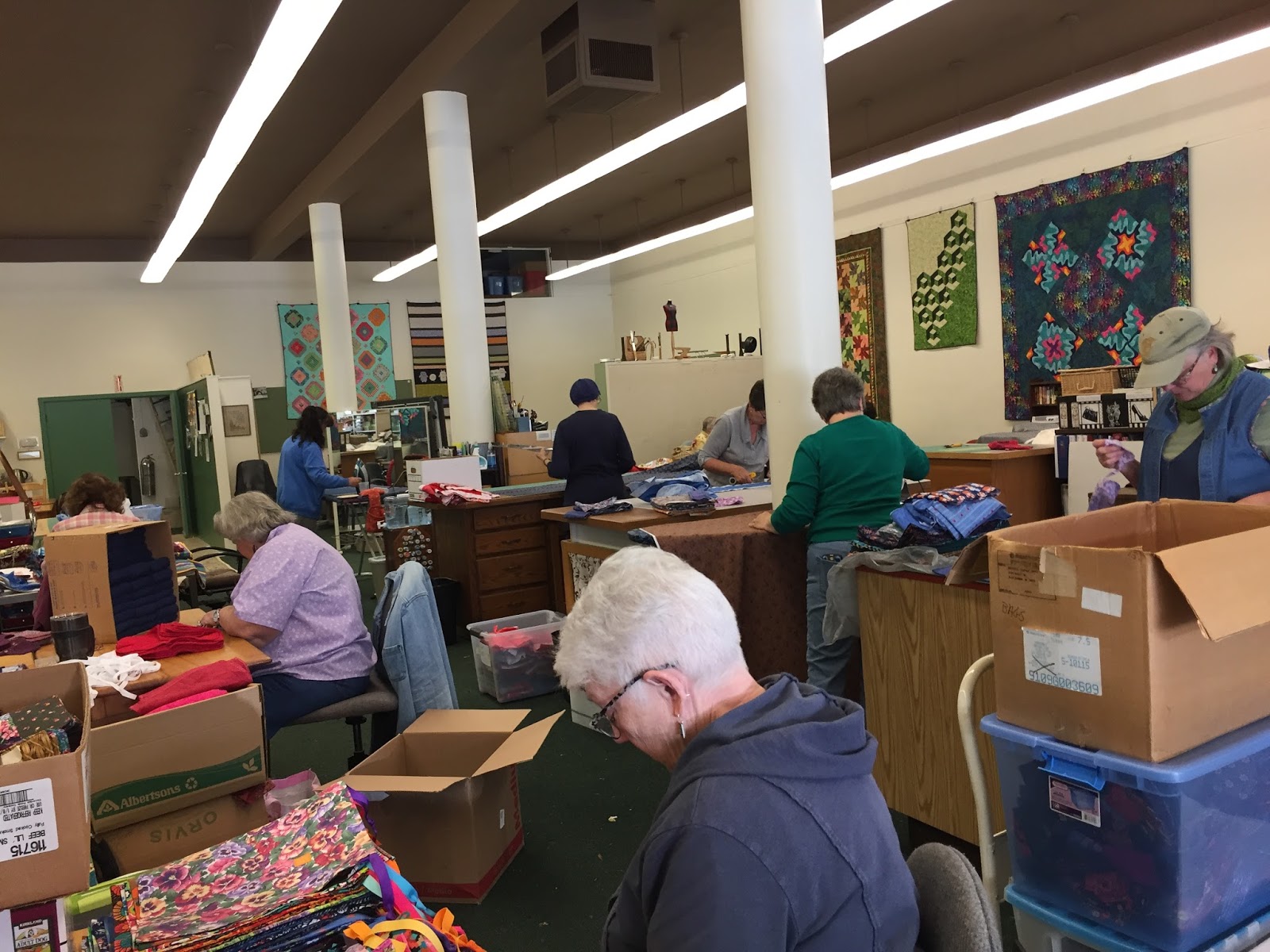
This past week, seventeen Oregon chapter and team leaders got together at The North Bank for lunch and idea and tip-sharing. I'd only met four of them in person previously, so appreciated this opportunity for sharing. What a great bunch of dedicated women! It was so interesting to hear how each group's "business model" varied, to meet their size and situation. One group meets 4 times a year, another twice a month, another irregularly. They're all envious of the lovely Our Sewing Room, and some have great places to store all their components, in progress and finished (although most of us have given up much of our homes to it, I think). I think we all came away inspired with some new tips that might work well for us, and are looking forward to more opportunities to collaborate.A GREAT OVERVIEW ARTICLE
Days for Girls continues to help focus the attention of the world on the issue of women needing appropriate ways to manage their periods. Read this article in ImpactAlpha.
INSTEAD OF ANIMAL MANURE
70 Interesting Facts about Menstruation

By Karin Lehnardt, Senior Writer
Published November 13, 2016

- A woman will spend approximately 3,500 days menstruating.[4]
- Walt Disney made a movie about menstruation titled “The Story of Menstruation” in 1946. It most likely is the first film to use the word “vagina.”[16]
- In Hong Kong, an Indonesian maid added her menstrual blood to her employer’s food in an attempt to improve their relationship.[5]
- The only mammals to undergo menopause are elephants, humpback whales, and human females.[9]
- Only the rhesus macaque at a 29-day cycle is close to the human menstrual cycle.i[9]
- The average women in a modern industrialized society menstruates 450 times in her life. Conversely, prehistoric women menstruated only 50 times—and today, women in agrarian regions menstruate about 150 times in a lifetime.[9]
- Many prostitutes don’t take time off for their period. They either wedge cotton balls up against their cervix or they take birth control pills to control menstruation.[9]
- Approximately 70% of women of menstruating age use tampons. A woman may use nearly 11,400 tampons in her life.[4]
- An entire menstrual period usually releases less than half a cup of blood, including clots.[12]
- The Romans attributed the deformity of the god Vulcan to the menstrual intercourse between his parents Juno and Jupiter.[4]
- The term “period” in reference to menstruation dates from 1822 and means an “interval of time” or a “repeated cycle of events.”[10]
- Another word for menstruation is “catamenia,” from the Greek katamenia (kata = by + menia = month). A “catamenia cup” is a firm, flexible cup worn inside the vagina to catch menstrual blood.[4]
- Menstruation may have led to humanity’s sense of time as most early lunar calendars were based on the length of a women’s menstrual cycle.[4]
- A New Guinea man divorced his wife because she slept on his blanket while menstruating. He later killed her with an ax.[3]
- Some cultures believed that menstrual blood could cure ailments such as warts, birthmarks, gout, goiters, hemorrhoids, epilepsy, worms, leprosy, and headaches. Menstrual Blood was also used to create love charms and to ward off demons. Additionally, a virgin's first menstrual napkin was thought to be a cure for the plague.[3]
- A girl's first menstrual period is called a menarche (from the Greek word men = month + arkhe = beginning). After the menarche, ovulation does not usually occur with menstruation for approximately the first year to 18 months.[3]
- When a girl is born, her complete potential egg supply is born with her. In the womb, she creates about seven million egg cells. At birth, she has two million. By puberty, there are only about 400,00 are left, of which fewer than 500 are actually released.[2]
- Scholars suggest that pre-modern men and women learned to think numerically by recognizing relationships between groups of numbers that were also units of time measured through menstrual rites.[4]
- The term “ritual” is derived from the Sanskrit word R’tu, which means “menstrual.” This etymology suggests that ritual in a general sense and menstrual acts have a common origin.[4]
- The human female egg is the largest cell in the human body. It is the only human cell that can be seen with the naked eye.[2]
- A small percentage of women experience endometrial sparing, when the body recycles the lining of the uterus instead of shedding it. Consequently, these women’s periods are very brief and light.[9]
- To treat extremely heavy periods, some women turn to uterine ablation. During a uterine ablation, a physician can use several types of methods—such as a laser, a balloon filled with a heated saline solution, electricity, freezing, or microwave—to permanently destroy the enodmetrium.[12]
- Up until the age of about 18, irregular periods are quite common because the body is still working on perfecting the system.[12]
- At one point in history, women who complained of menstrual cramps (dysmenorrhea) were sent to psychiatrists because menstrual cramps were seen as a rejection of one’s femininity.[3]
- Researchers have demonstrated that female prison inmates are much more likely to commit a violent crime premenstrually than postmenstrually.[4]
- Periods tend to be heavier, more painful, and longer in the colder months.[4]
- Oligomenorrhea is when a woman has her periods less frequently than normal. Amenorrhea is when she doesn’t get her period at all.[9]
- A young woman can get her first period anywhere between 10 and 16 years of age. Delayed onset of menstruation is rare, but if a girl hasn’t started by the age of 16, she should see a gynecologist. In the United States, 97.5% of women have begun their menstrual cycles by the age of 16.[9]
- Menstruation is the shedding of the uterine lining, or the endometrium. It is the most visible phase of the menstrual cycle.[2]
- Judaism, Hinduism, and Islam all prohibit sex during menstruation. Both Jews and Muslims require women to achieve ritual purity after menstruation, through the Jewish mikvah(literally “collection,” as in a collection of water) or the Islamic ghusl (ablution), respectively.[13]
- Tampon is French for “plug” or “bung,” a variant from the Old French tapon meaning a “piece of cloth to stop a hole.” Before the creation of tampons in the 1920, Western women used reusable rags. Some scholars suggest that premodern women just bled into their clothes, especially since they had fewer menstrual cycles than modern women.[4]
- Nicknames for a menstrual period include Aunt Flo, On the Rag, I’m at a Red Light, Surfing the Crimson Tide, Checked into Red Roof Inn, Curse of Dracula, Leak Week, My Dot, and Monthly Oil Change.[12]
- Scholars debate the existence of menstrual synchrony (a.k.a. the McClintock effect or dormitory effect), a theory that suggests that women who live in close proximity to each other develop synchronized periods.[9]
- Heavy bleeding is defined as passing more than one cup of blood per cycle, soaking through a pad or tampon every hour for six hours in a row, or having a period that lasts more than seven days.[12]
- Some women are heavy clotters and pass chunks of coagulated blood during their periods. The clots come from uterine contractions and cramping so frequent that the blood doesn’t have time to thin out before passing. A few dime size or smaller clots a day during a period is normal.[12]
- Using a tampon can’t “de-virginalize” a person. A virgin (from the Latin virga,meaning “young shoot”) is someone who has never had sexual intercourse. While some cultures view the unbroken hymen as a mark of virginity and the tampon may damage the hymen, in fact, the hymen may or may not break during sexual intercourse and may even break by medical exams or rigorous physical activity.[12]
- A tampon does not make a woman bleed more than if she uses a pad.[12]
- Ancient Egyptians used softened papyrus as rudimentary tampons. Hippocrates notes that the Greeks used lint wrapped around wood. The modern tampon was invented by Dr. Earle Haas in 1929, which was called a “catamenial device” or “monthly device.” He trademarked the brand name Tampax.[6]
- It is possible to get pregnant if a woman has vaginal sex during her period because sperm can survive up to a week in the body.[12]
- A woman who has excessive bleeding may suffer from menorrhagia, a condition in which the uterine lining builds up very thick. Very heavy bleeding could also indicate a thyroid problem or fibroids (growths on the uterus).[9]
- Eighty-one percent of women say they’ve experienced dysmenorrhea (painful cramps). This occurs because the prostaglandin hormone causes the uterus to cramp, causing the abdomen to spasm.[9]
- Nearly 15% of menstruating women suffer from debilitating cramps. Scientists claim they have created a pill known as VA 111913 that eliminates most menstrual cramping.[7]
- The Mae Enga people of Papua New Guinea believe that contact with menstrual blood or a menstruating woman will “sicken a man and cause persistent vomiting.” It will also “kill his blood so that it turns black, dull his wits, and lead to a slow death.”[3]
- Pliny describes in his Natural History that the “horrible” smell of menstrual blood drives dogs mad and even ants will throw away grains of corn that have been touched by it.[3]
- Smoking cigarettes can kill a woman’s eggs and cause menstrual periods to stop prematurely.[1]
- In the eighteenth century in Saigon, no woman was employed in the opium industry because it was believed that if a menstruating woman were near, the opium would become ruined and bitter.[3]
- In the 1920s, Viennese scientist Bela Schick coined the term “menotoxins” to describe what he believed were plant-destroying substances that escape through the skin of menstruating women. He notes that menotoxins prevent dough from rising and beer from fermenting.[3]
- The same chemicals that cause uterine contractions during menstruation also cause the lower intestine to contract as well, which can lead to diarrhea.[12]
- Studies suggest that city lights or artificial lights influence the menstrual cycle.[8]
- The average age a woman stops her period is 51, though symptoms of menopause (perimenopause) can start as early as 32.[1]
- The term “menstruation” is equivalent to the Old English monadblot or “month blood.” In Latin, menses means “month.”[10]
- The family of words that are related to the English word “menstruation” include mental, memory, meditation, mensurate, commensurate, meter, mother, mana, magnetic, mead, mania, man, and moon.[4]
- In many cultures, a fetus was thought to be formed in the womb by clotting menstrual blood.[4]
- Menstruating blood was often seen as sacred. Sacred means both “set apart” and “cursed.”[3]
- In the past, Christian churches refused communion to menstruating women.[3]
- In some parts of India, a woman indicates she is menstruating by wearing a handkerchief around her neck stained with her menstrual blood.[4]
- During the nineteenth century, it was widely thought that intercourse with a menstruating women would transmit gonorrhea, which may have been mistaken for trichomoniasis. Trichomoniasis becomes worse during menstruation because of lower vaginal acidity.[4]
- The term “ovary” is from the Latin ovum or “egg.” In classical Latin, ovaries meant “egg keeper.”[4]
- During the menstrual cycle, an egg is released and travels down the Fallopian tubes (named after Gabreillo Fallopio (1523-1562), who first described them) to the uterus. If a sperm does not fertilize the egg, the egg and lining from the uterus is expelled, creating menstruation.[4]
- The word taboo comes from the Polyneisain tapua, meaning both “sacred” and “menstruation.”[4]
- Because women weigh more than they did in the past, women tend to start their periods at younger ages and stop them at older ages (fat cells produce more estrogen). Scholars also suggest that hormones in modern food have led to earlier menstruation.[9]
- In German, the word for menstruation is regel, in French it is regle, and in Spanish it is las reglas—which all mean “measure” or “rule” as well as “menstruation” and are cognate with “regal,” “regalia,” and “rex” (king). These terms suggest menstruation is linked to orderliness, ceremony, law, and leadership.[4]
- Menstruation huts were common features in premodern cultures. They were a place where women were separated from the community during their menses for various reasons ranging from fear to respect.[4]
- Scholars suggest that as matriarchy gave way to patriarchy, menstrual blood taboos were used by men to control women and, consequently, menstrual blood was interpreted away from something powerful to a “disgusting” waste product that had no role in the reproductive process.[3]
- Some scientists have suggested harvesting stem cells from menstrual blood.[11]
- Some scientists suggest that premodern women, who had no nightlighting, ovulated with the full moon and menstruated on a new moon.[4]
- Psychoanalysts, such as Freud, have suggested that menstruation is a “bloody sign of a woman’s loss of penis” and that it is a reminder of a woman’s “uncleanliness and inferiority.”[3]
- Scholars suggest that marriage rites are an extension of menarchal rites, which may explain why many bridal dresses were historically red. The bride would also walk on a red carpet to the wedding ceremony, wearing a red veil.[4]
- Because zero-gravity affects blood flow, NASA initially worried that a menstruating woman would die in space.[15]
- Women are more likely to go on a shopping spree 10 days before their periods begin as a way to regulate their fluctuating emotions.[14]
Historically, professional women tended to use tampons than pads

Menstrual cycles helped humans develop a sense of measurable time

Women who have seasonal affective disorder may also suffer more severe PMS symptoms

There’s no solid evidence of menstrual synchrony at the moment

Tampons have made of nearly everything you can think of . . . and more

Smoking can change hormonal balance and affect menstrual cycles

When she bleeds the smells I know change colour. There is iron in her soul on those days. She smells like a gun.
- Jeanette Winterson

Early puberty onset is becoming the norm

By nature, women are lunar
KEYWORD TAGS
REFERENCES
1Crossley, Jennifer. “Just the Facts. Period.” Times Daily. May 12, 2008. Accessed: February 27, 2010.
2Daniels, Patricia, et al. Body: The Complete Human. Washington, D.C.: National Geographic Society, 2007.
3Delaney, Janice and M.J. The Curse: A Cultural History of Menstruation. Champaign, IL: University of Illinois Press, 1988.
4Grahn, Judy. Blood, Bread, and Roses: How Menstruation Created the World. Boston, MA: Beacon Press, 1993.
5Hart, James. “Maid Put Menstrual Blood in Her Boss’ Soup, Hong Kong Police Say.” USLaw. Accessed: February 27, 2010.
6“History of Tampons and Tampax.” Tampax. Accessed: February 27, 2010.
7James, Susan Donaldson. “New Drug May Lift Curse of Menstrual Cramps.” ABCNewsHealth. October 13, 2009. Accessed: February 27, 2010.
8Lin, M.C. et al. “Night Light Alters Menstrual Cycles.” Psychiatry Res. 1990. Aug 33(2): 135-8. PubMed.gov. Accessed: February 27, 2010.
9Livoti, Dr. Carol, and Elizabeth Topp. Vaginas: An Owner’s Manual. New York, NY: Thunder’s Mouth Press, 2004.
10“Menstruation.” Online Etymology. Dictionary. Accessed: February 27, 2010.
11Mitchell, Steve. “Menstrual Blood Tapped as a Source of Stem Cells.” MSNBC. November 30, 2007. Accessed: February 27, 2010.
12Redd, Nancy Amanda. Body Drama. New York, NY: Gotham Books, 2008.
13Shaikh, Sa’diyya. 2003. “Family Planning, Contraception, and Abortion in Islam: Undertaking Khalifah” in Sacred Rights: The Case for Contraception and Abortion in World Religions, ed. by Daniel C. Maguire. New York, NY: Oxford University Press.
14"Shopping Sprees Linked to Periods." BBC. March 30, 2009. Accessed: June 16, 2017.
15Teitel, Amy Shira. "A Brief History of Menstruating in Space." Popular Science. June 10, 2016. Accessed: June 16, 2017.
16“Trivia for The Story of Menstruation.” IMDB. Accessed: February 27, 2010.